
 14 Minutes


Key Takeaways
- During the holiday season, spending hits its highest point, yet financial challenges differ across regions. Tailor your strategies to reflect these unique local spending habits to truly engage consumers.
- Understanding cultural nuances, such as Italy’s emphasis on family feasts or Germany’s reflective traditions, helps brands craft campaigns that feel authentic and meaningful.
- Leverage ecommerce trend insights to refine your online presence, ensure seamless customer experiences, and align your strategies with consumer expectations in this fast-paced environment.
The Spirit of Christmas: Are Joy and Tradition Holding Strong?
Regardless of religious or cultural traditions, Christmas has long been associated with a time to pause, reflect, and share moments of joy with loved ones.
This is still true today, as per our latest omnibus survey, conducted in November 2024 across five European countries (UK, Germany, Spain, France, and Italy, with a total sample of 6,170 respondents). Although the tradition of Christmas is still upheld across these countries, there are some significant differences in attitudes and behaviors between them.
From festive feasts and cherished family gatherings to the way holidays are spent and celebrated, each country brings its own cultural flavor to this time of year. Christmas is deeply tied to emotions like nostalgia, generosity, and togetherness. Tapping into these sentiments effectively can strengthen loyalty and create lasting impressions.

When Is Christmas Celebrated?
In Europe, „Christmas“ (or the local word for it) refers not to the day but the whole season, which stretches well over a month — not to extend the shopping season, but to fit in the many holy days and festivities.
The five countries in question tend to celebrate the season slightly differently. In the UK, the main Christmas celebration consists of a meal usually eaten at lunchtime or early afternoon on Christmas Day. Unlike other European countries, Christmas Eve is often a little chaotic in homes and towns up and down the country. For some, it’s the last chance to buy gifts for loved ones – with shops typically closing early.
In Germany, however, Christmas (Weihnachten) is a three-day holiday. The main celebration is on Christmas Eve (Heiligabend), Dec. 24. Shops and offices are usually open until noon (unless it is a Sunday), and then everything closes for a mainly silent and quiet time spent with family. Germans love a traditional Christmas dinner on Dec. 24.
As is the case in Germany, for the Spanish, the most special night is Dec. 24 (Christmas Eve), when restaurants and hotels offer extraordinary menus to celebrate it in a big way. Christmas (Navidad) is perhaps the most traditional, family-oriented celebration in the whole world, and in Spain it lasts until Jan. 6.
As for the French, the main Christmas meal (le réveillon de Noël) traditionally took place on Dec. 24, however, tradition is changing and many people in France now celebrate either on Dec. 25 or even both days. It’s not rare for couples to have two Christmas meals as they would spend Christmas Eve with one family and Christmas Day with the other.
For the Italians, Christmas is a season of plenty, and they celebrate with copious feasts spanning up to seven hours on Christmas Day (Dec. 25)! Everyone in the family brings their delectable recipes, giving each gathering its unique flavor. On Christmas Eve, Italians observe the tradition of La Vigilia di Natale and abstain from eating meat.
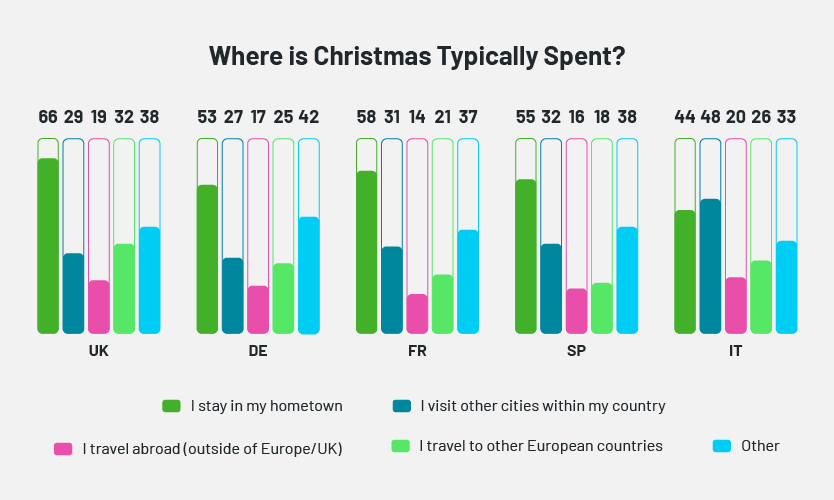
Where Is Christmas Typically Spent?
Europeans typically spend Christmas in their hometowns, especially the British. Italy, once again, is the least conforming to this trend, with a similar number of Italians visiting other cities in their country as those remaining in their hometowns.
Taking Holidays Over Christmas
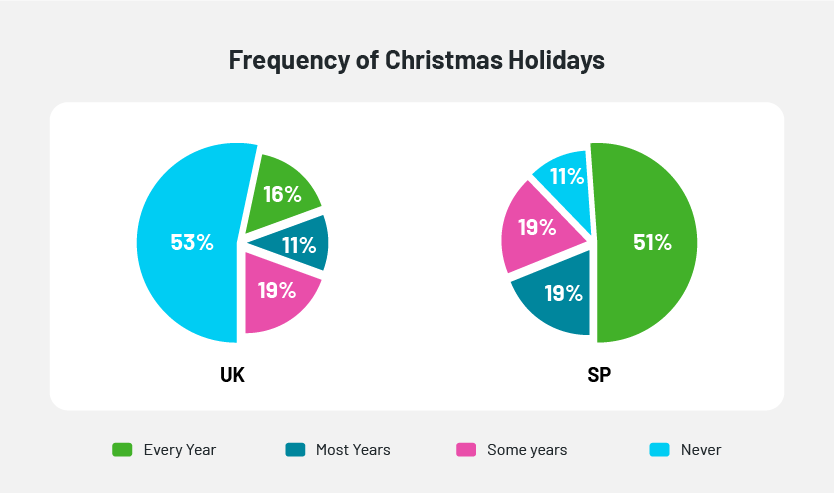
Our study revealed some stark differences between countries when it comes to taking holidays over the Christmas season. In the UK, for example, more than half the respondents ‘never’ take holiday over Christmas. The opposite is true for Spain, where over half the respondents take holiday over Christmas ‘every year’.
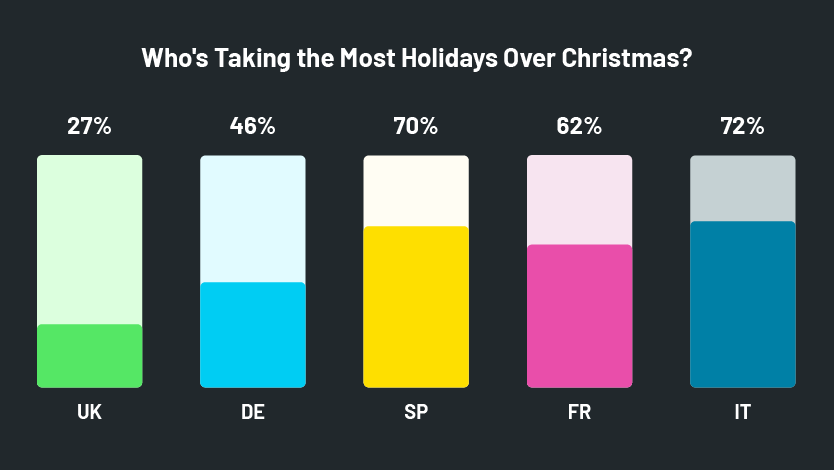
When combining the frequency of taking holidays Every and Most years, Spain and Italy dominate the Christmas holiday season, with France close on their heels. However, UK and Germany feel very differently about this, as depicted in the below graph:
There are several reasons why the British take fewer holidays over Christmas to celebrate:
- The financial impact is a huge burden (stressful) and is becoming increasingly so.
- I can’t see all my family because traveling is too expensive. (UK)
- Expensive, very stressful, long day, indulgent, glad when it’s over. (UK)
- It’s an expensive commercial holiday that puts people in debt to fulfil expectations. (UK)
- Christmas is cancelled this year due to lack of money. (UK)
- For many it is a sad time (remembering those who have passed on).
- It is a painful time of year thinking of those who have died. (UK)
- Christmas has become too commercialised with the true meaning being lost over the years.
- A stressful time that I hate due to the lack of the real meaning of Christmas being lost to the commercial aspect of this holiday. (UK)
- Overpriced hyped up expectations. (UK)
- Hassle of feeling I have to meet others expectations, and guilt when I don’t. (UK)
This being said, there is a dichotomy amongst the Brits – the negativity that reigns due to budget/financial constraints versus the need for upholding the tradition of celebrating the season with family and friends.
-
- Christmas is beautiful, even the thought of Christmas brings joy. It means so much because of the way it is, and you get to spend time with your family and friends. It also brings excitement gifting and receiving gifts. It just all seems like pure love. (UK)
For the Germans, it’s less about the financial burden of Christmas, but more about the stresses associated with gift buying and traveling over this period. Even though this was the sentiment of some, the Germans still celebrate Christmas by sharing, reconnecting and enjoying special moments with family during this special time. So, whilst they are not necessarily taking holidays over this period, they are celebrating with their loved ones, relaxing and re-energizing.
-
- For me, the days off during the Christmas period actually mean a lot of stress. Buying and giving the right presents for all family members and friends is simply a lot of work. Sometimes, of course, there are also nice moments due to the Christmas spirit and the close get-togethers and celebrations. (DE)
„For me, Christmas is a dream that I can experience with the beautiful Christmas atmosphere, with snow and with the family and it is once a year and a very great feeling.“ (DE)
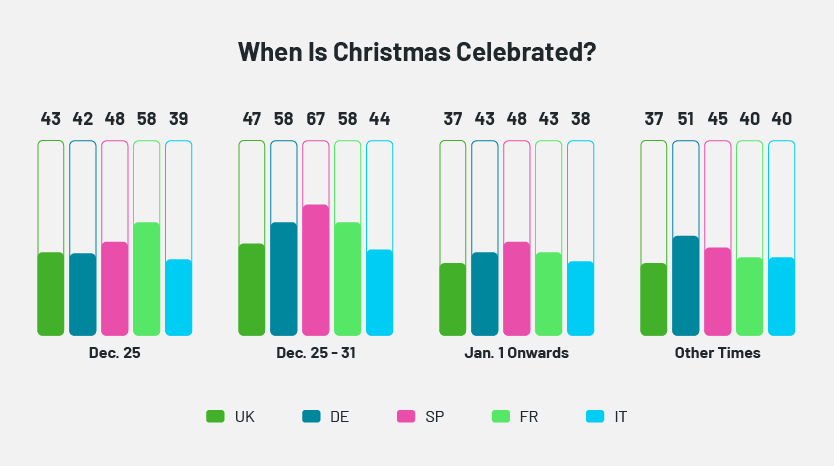
In central Europe, for those who take holidays during this season, the frequency of celebrating Christmas around Christmas week (Dec. 25 – 31) is more prominent than in the UK. In France, the build-up to Christmas (before Dec. 25) and Christmas week are the times when the majority take a break. In Spain, the Christmas week is the most prominent, yet in Germany respondents tend to have a higher propensity to taking holiday at a different time of year – more than the rest.
Traveling During the Christmas Period
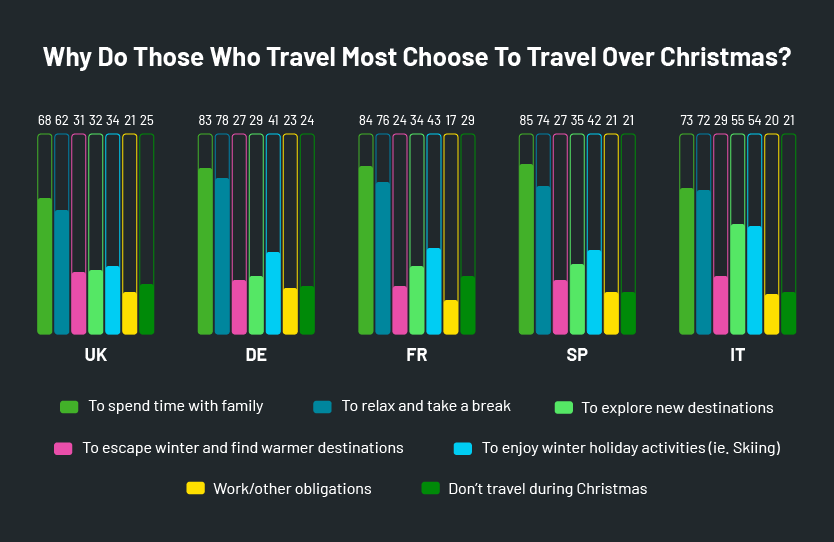
Those that do travel over the Christmas period in Europe do so primarily to spend time with family and to relax and take a break. When comparing countries, it is evident that the Italians enjoy exploring new destinations and winter activities more so than their European neighbors.
-
- It’s an occasion to spend with family possibly in the mountains. (IT)
- Entertainment, leisure, snow, time spent with friends and family. (IT)
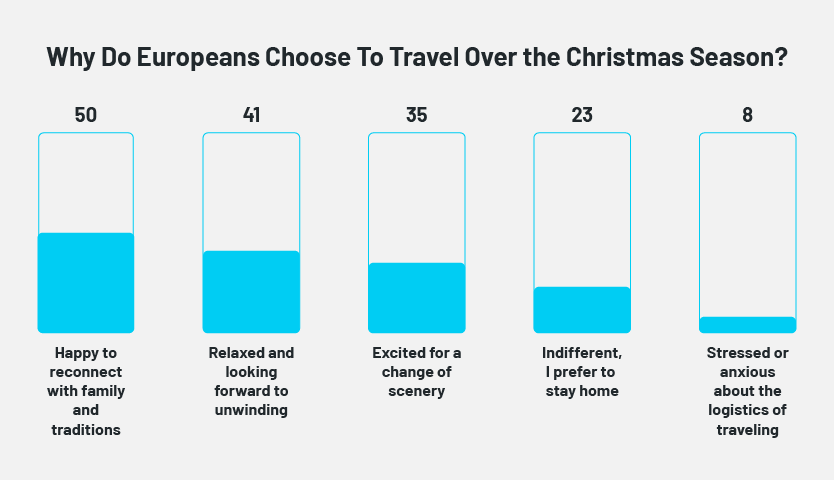
On average, half the European respondents are happy to travel to their family members to spend time with them and reconnect over the Christmas period. As was mentioned earlier and is again reflected here, the British have less of an interest in traveling over this time, with only 35% happy to do so, whilst 23% felt indifferent – preferring to stay home over this period. The country with the lowest ‘indifference sentiment’ is Italy (only 14% prefer to stay home).
For the Italians, Christmas is about re-connecting with family and celebrating it through traditional food and activities:
-
- It is a celebration that brings us together, even if we were far apart during the year. (IT)
- The Christmas vacations are a magical time of sharing, warmth and precious memories with the people I care about most. (IT)
- The Christmas vacations are the smell of freshly baked panettone, Christmas songs in the background, and the warmth of gathering together in front of a table laden with delicacies, immersed in an atmosphere of magic and affection. (IT)
Like the Italians, the other countries share their sentiment of Christmas as a time of family bonding and sharing special memories:
-
- A time to cherish and relax with my family and demonstrate how I care for them. (UK)
- Christmas is a time to get together with family, share love and joy and create memories that will last a lifetime. (DE)
- A moment not to be missed, to be with family, to say that we love each other and that’s all that’s real, family. (FR)
- The Christmas holidays are mostly about sharing and enjoying the people you love and cherish and the little pleasures of life. (SP)
Motivations and Feelings Toward Christmas
As already mentioned, the tradition around celebrating Christmas and the enjoyment thereof with family and friends are the strongest motivators for most Europeans. Visiting Christmas markets (16%) and enjoying the winter holiday (19%) over this period, are less enticing to the British, with a large lower than average score for these two motivators.
In Italy, the cultural expectation around the celebrating of Christmas is a bigger motivator than the other countries (50%).
Below % Responses to ‘Always feel this way’.
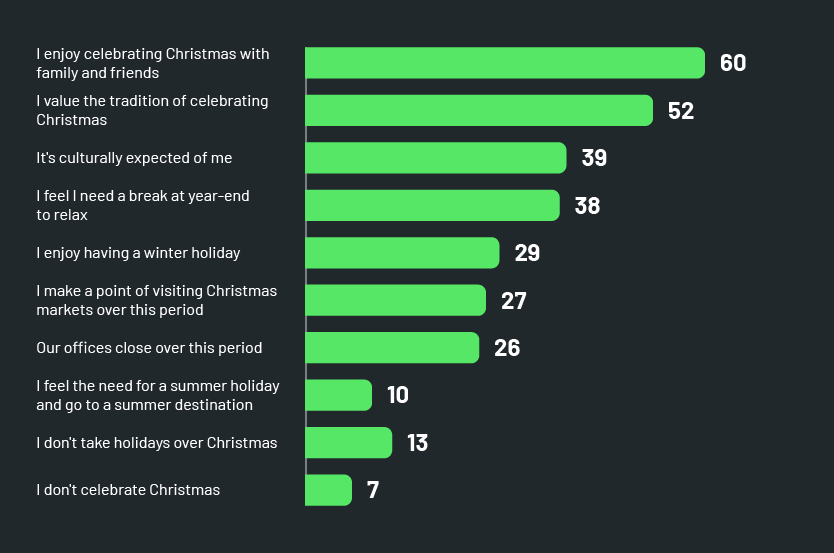
Across all countries, the following themes are evident regarding feelings about Christmas.
- Re-connecting with family – sharing memories and making new ones:
- Warmth, family reunion, whole family happiness. (UK)
- Christmas is a time to get together with family, share love and joy and create memories that will last a lifetime. (DE)
- Christmas vacations are a time for getting together as a family. It’s a somewhat “magical” time of year, when you can feel everyone’s excitement. (FR)
- Happy time to be with the family celebrating. Reunion with loved ones. (SP)
- Unforgettable moments with family especially with children everything is magical. (IT)
- Unwinding, relaxing and re-energizing for the year ahead:
- A good time to unwind, chill, be grateful for year-round events, reminisce. (UK)
- They mean finding time for my inner peace and recharging my batteries for my family. Time for reflection and contemplation, as well as time to relax. (DE)
- The Christmas vacations are a time of pause and reflection for me. (FR)
- To be able to disconnect from my usual work routine and share moments and time with family. (SP)
- The Christmas vacations are a time for me to pause and reflect, a chance to be with loved ones and rediscover the magic of small things. They are days of warmth, tradition and serenity, when I can regenerate and regain balance. (IT)
- Nostalgia – childhood memories and the longing for loved ones:
- The love and memories of friends and family we all remember and lose through our life. (UK)
- A contemplative time with the family, thinking of those gone. (DE)
- The magic of my childhood reappears. (FR)
- An endearing holiday that awakens the illusion of our inner child. (SP)
- These are celebrations that I always remember with special affection. because in my childhood they were always very special celebrations. (SP)
„The Christmas vacations are a magical time of sharing, warmth and precious memories.“ (IT)
Consumer Behavior Changes During the Holiday Season: The Importance of Market Research
- Budget and Spending
Increased spending: The holiday season triggers a peak in consumption, with a notable rise in spending. Having said this, it is important to note the differences in these spending patterns between countries. For example, the British are feeling the economic pressures and need to tame their budget and shop wisely and somewhat differently than in the past.
Dedicated budget: Consumers often allocate a specific budget for holiday shopping, prioritizing expenses related to gifts, decorations, and festivities.
Advanced planning: Most consumers plan their holiday spending well in advance to organize purchases and take advantage of the best promotions.
Market research helps to analyze these purchasing behaviors, identify trends, evaluate them, and understand them to tailor business strategies for this period. - Emotional FactorsDuring this season, consumers are particularly sensitive to values of sharing and togetherness. Spending time with family and friends becomes a priority. Emotional marketing, focused on themes like family, generosity, and shared moments, can enhance brand perception. Market research helps to test and measure the effectiveness of emotional marketing campaigns by assessing the impact of these messages on purchase intentions.
- Online Shopping Practices
Growing e-commerce: With the rise of online shopping, it is crucial to monitor online purchasing behaviors, delivery times, and customer reviews.
Impact of social media: Social platforms increasingly influence purchasing decisions through targeted advertising, influencer recommendations, and shared gift ideas. Market research enables businesses to identify these digital trends and adjust strategies to optimize their online presence and meet consumer expectations.
Impact on Market Research Practices
The Christmas season plays a role on the success of market research projects in the following ways:
- Lower availability of respondents from pre-Christmas season (before Dec 25) to post-Christmas (Jan. 6).
- Potential higher fall-out/no show rate.
- Different frame of mind than usual affecting peoples’ buying behaviors and habits, which could potentially skew findings, depending on the topic at hand.
The sentiments and traditions of celebrating Christmas in Europe not only embody joy, tradition, and togetherness but also provide valuable insights into consumer behavior during the holiday season. Understanding the spending patterns, the emphasis on emotional connections, and the growing influence of online shopping practices can significantly impact businesses‘ strategies. Integrating these insigts can enhance brand perception and engagement and foster long-lasting relationships with consumers during the festive season and beyond.


![[OnDemand] Promotions + AI: Lift Sales Without Losing Your Brand](https://sago.com/wp-content/uploads/2026/06/blake-wisz-tE6th1h6Bfk-unsplash-scaled.jpg)

![[OnDemand] Why You Should Develop a Data Quality Tech Stack](https://sago.com/wp-content/uploads/2022/09/Single-Sign-On-Methodify.jpg)