 8 Minutes


Key Takeaways
- Northern European countries like Germany and the UK maintain a different rhythm during August compared to Southern European countries like Italy, Spain, and France, which tend to shut down.
- For all the countries surveyed, spending time with loved ones and avoiding burnout are the main reasons for their summer vacation choices.
- It’s critical to strategically plan timelines and employ flexible methodologies for market research projects during this period in Europe.
Need help with your European insights projects? Our team has the expertise to guide you to success.
As summer settles over Europe, the usual pace of life slows down. In countries like Spain, Italy, and France, August—and to a lesser extent, July—is when daily routines shift from their usual activity to a more relaxed state. Streets, offices, and businesses, usually bustling with activity, quiet down as if the continent collectively exhales. This slowdown is not merely a break from work; it’s a way of life in countries like Spain, Italy, and France. For Sago, understanding this seasonal shift is crucial for adapting our research approach during these quieter months.
August: The Month Europe Goes on Vacation
Our July 2024 omnibus survey, which spanned Germany, Spain, France, Italy, and the UK with 5,000 respondents, reveals some fascinating trends. August is the month when Europe goes on vacation. In Spain, nearly 60% of the population takes their break during this time, with similar patterns seen in Italy and France. Even in Germany, where business often takes precedence, 44% of people prefer to vacation in August. The UK, however, spreads its vacations more evenly between June and September, offering a bigger opportunity for those who need to target British consumers during the summer.
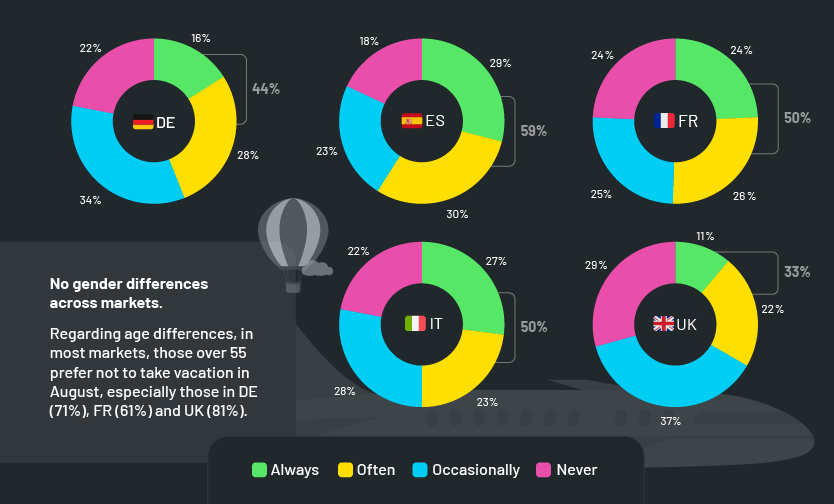
But each country has its unique twist. While August is the peak holiday month, the behavior and patterns vary:
- United Kingdom: August leads with 11% of people taking time off, with July also popular. Younger Brits, who are particularly drawn to outdoor activities (35%), plan vacations around school breaks (21%).
- Italy: August dominates, with 27% of Italians taking a break, significantly more than the 10% in July, 9% in September, and 8% in June. July remains popular, with 30% frequently vacationing. Regional preferences show that Southern Italians are more inclined to vacation in August. This aligns with the celebration of Ferragosto on Aug. 15—rooted in ancient Roman harvest festivals—marking the peak of summer. This national holiday triggers widespread business closures as Italians embrace the philosophy of la dolce vita—“the sweet life,” where relaxation and well-being take precedence over productivity.
- Spain: August is the top choice, with 29% taking holidays regularly and 30% frequently. July and September see fewer holidays, with 14% and 11% taking regular breaks, respectively. Like Italy, Spain experiences widespread closures of offices and small businesses as people escape the hot urban environments for the cooler coastlines. This exodus reflects a cultural emphasis on taking time off to recharge, deeply embedded in Spanish life.
- France: August remains strong with 24% taking time off consistently and 26% frequently. July follows, with 13% traveling regularly and 25% frequently. September sees a drop, with 40% not taking vacations. Younger French travelers (18-34) prefer August (30%). The grandes vacances, or „great vacations,“ represent a time for the French to disconnect from work and focus on relaxation, family, and leisure, with many businesses, particularly smaller ones, shutting down for weeks.
- Germany: August is prominent with 24% taking vacations, a notable increase from 13% in July and 9% in June. September sees 29% of Germans not taking any holidays, highlighting a clear preference for summer. Unlike their southern counterparts, Northern European countries like Germany and the UK maintain a different rhythm during August. Businesses generally remain operational, with fewer closures and a more pragmatic approach to vacation time. This reflects a preference for shorter, more frequent holidays, often timed to avoid peak summer heat and high travel costs.
What Drives Europeans‘ Summer Vacation Choices?
European holiday choices reflect a mix of personal desires, cultural quirks, and practical considerations. In Germany, for example, 55% prioritize spending time with loved ones, and 42% seek to avoid burnout. Personal preferences often outweigh cultural traditions, especially in Southern Germany, where 76% avoid peak summer months due to crowding and costs.
In France, the focus is on personal well-being and work-life balance, with 51% citing the need to spend time with loved ones and avoid burnout as the primary motivators for taking time off. Regional differences show higher August travel rates in Sud-Est, while older French age-groups avoid peak summer due to tourist crowds and high prices (57%).
Spain and Italy both emphasize recharging and avoiding burnout as the main driver for summer travel, with 55% of Spanish respondents and 50% of Italians citing these reasons. In Spain, cultural traditions are less significant (16%), while in Italy, only 29% view vacations as a cultural expectation.
The UK blends personal and cultural factors, with 48% prioritizing time with loved ones and 44% seeking to avoid burnout. While cultural traditions are present, they play a lesser role compared to personal and practical motivations.


The Impact on Market Research and Business Operations
But what does this all mean for market research? Understanding these vacation patterns allows us to anticipate challenges and adjust our methodologies accordingly. For example, recruiting participants during these months can be challenging, requiring us to employ more targeted and creative recruitment strategies to ensure we gather representative data. Understanding consumer behavior during this period offers unique insights into their preferences and motivations.
By strategically planning our research timelines and employing flexible methodologies, Sago can navigate these challenges and deliver high-quality insights, even during the summer months. For instance, we might shift our focus to regions like the UK, where vacation patterns are more evenly spread, or we might explore alternative data collection methods that are less reliant on direct participation.
In a business environment that pauses for vacation, Sago keeps moving, adapting our approach to ensure that we continue to deliver the insights our clients need to succeed—even when the rest of Europe is on holiday.

![[OnDemand] Promotions + AI: Lift Sales Without Losing Your Brand](https://sago.com/wp-content/uploads/2026/06/blake-wisz-tE6th1h6Bfk-unsplash-scaled.jpg)

![[OnDemand] Why You Should Develop a Data Quality Tech Stack](https://sago.com/wp-content/uploads/2022/09/Single-Sign-On-Methodify.jpg)